

Merger control

When assessing mergers that could raise competition concerns, competition authorities often rely on economic evidence to evaluate competitive effects.
-
+ We have supported merging parties and third parties in merger investigations, from targeted support on specific workstreams to leading the economic analysis for a competition authorities in a complex Phase II review.
+ We develop rigorous economic evidence tailored to the specific theories of harm and industry dynamics under consideration, helping clients engage effectively with competition authorities.
+ We have deep expertise in complex commercial datasets, bidding data, customer-level and survey data, and more qualitative evidence across a wide range of industries.
+ You get direct access to senior economists without layers of delegation.
Investigations have become increasingly data-intensive, with evolving theories of harm, particularly in digital, innovative and highly concentrated markets
-
Drawing on our deep grounding in economic theory and econometrics and broad experience across competition matters, we help clients address increasingly complex economic questions relating to:
+ Price and non-price competition
+ Dynamic effects on innovation, investment, and future competition
+ The role of data, network effects, ecosystem leverage and other digital market-specific competition concerns
+ Early assessment of merger-specific efficiencies, including sustainability and resilience benefits (“Theory of Benefits”)
+ Forward-looking counterfactual analyses and failing firm defences
+ Evolving theories of foreclosure and market power in vertical and conglomerate acquisitions
Project news »

Talks »


« Deep dive


The context
A cornerstone of competition law, merger control seeks to prevent structural changes that could significantly lessen competition. Each year, competition authorities review hundreds of mergers under the relevant merger control regime to assess their competitive effects. While notification is mandatory above specified thresholds in jurisdictions such as the EU and Germany, the UK operates a voluntary regime under which the CMA investigate transactions that may raise concerns.
Higher BKartA merger notification threshold effective in 2021
No compulsory merger notification in the UK
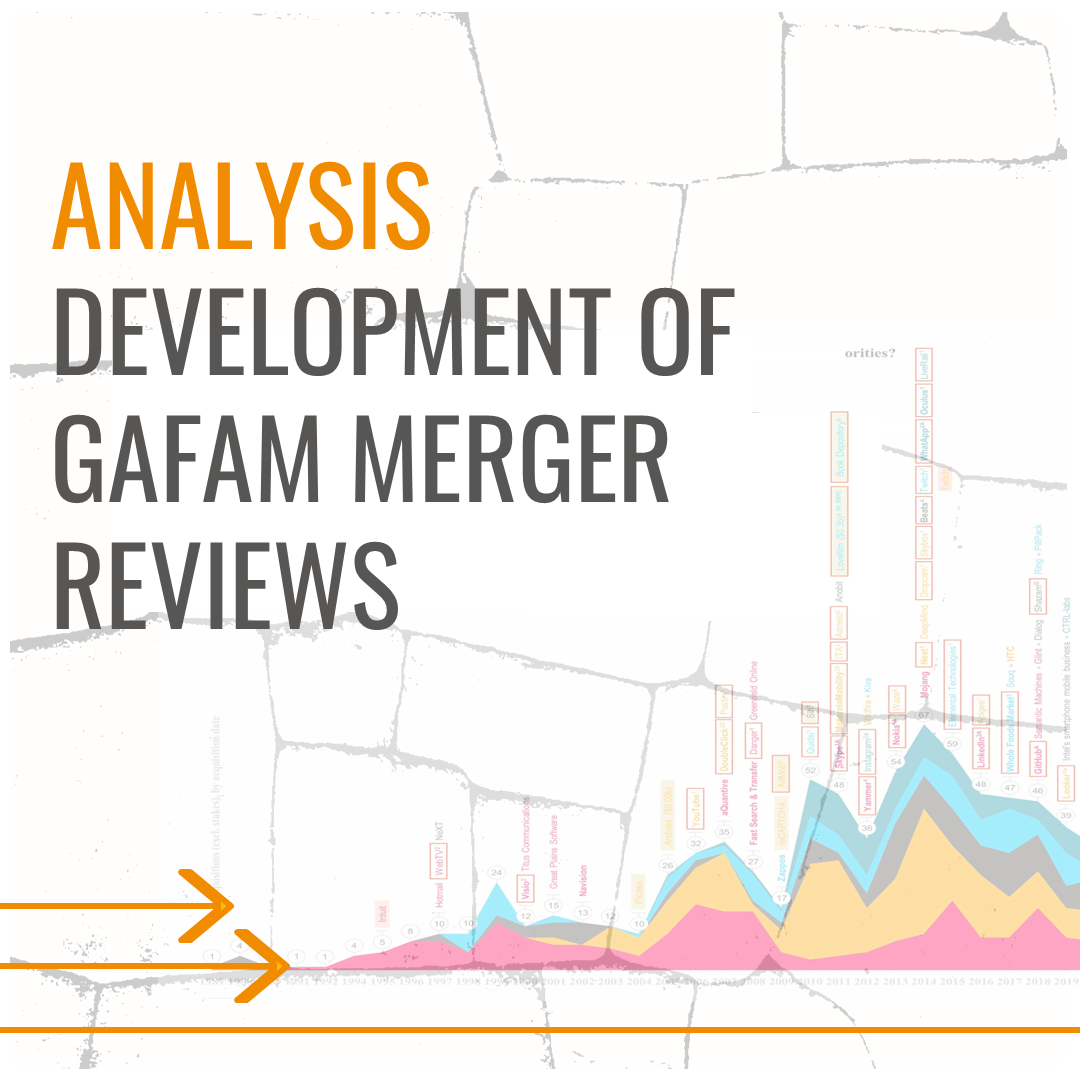
Irrespective of the regime, merger investigations have become considerably more data-intensive over time and authorities have developed increasingly sophisticated theories of harm to assess potential competitive effects. To illustrate how theories of harm have evolved in digital mergers, see our Deep Dive below, where we analyse completed merger decisions by the European Commission, the CMA and the Bundeskartellamt.
ECONOMIC QUESTIONS
We address the economic questions arising throughout the merger control lifecycle.
-
+ Pre-notification, we identify competition concerns and assess the risk of an in-depth investigation.
+ Phase 1 work often focuses on market definition and targeted empirical screens (e.g., for closeness of substitution).
+ Phase 2 may require complex, data-intensive analyses to test theories of harm, substantiate efficiencies and design effective remedies.
+ In Appeals, we provide economic expertise before national and European courts
Our analytical approach combines quantitative analysis with qualitative evidence to assess how competition works and how markets are delineated.
-
We tailor our approach to the unique characteristics and dynamics of your industry - from commodity markets to complex offerings such as digital platforms - and help legal teams assess and respond to the specific theories of harm shaping your matter.
+ Unilateral effects: potential effects on prices, quality or innovation, using tools ranging from market-share analysis to merger simulation.
+ Coordinated effects: whether a merger facilitates collusion.
+ Vertical & conglomerate effects: potential foreclosure, bundling and concerns involving digital ecosystems or data-based advantages.

AIB / ULSTER BANK
Our role
We provided project management and expert analysis, including market definition, competitive assessment based on large-scale data collection and counterfactual analysis.
The results
The case was cleared after a phase 2 investigation based on the counterfactual. While the CCPC acknowledged that the exit of Ulster Bank raises competition concerns in the markets for commercial loans, the sale of the loans following Ulster’s decision to withdraw from Ireland was not deemed to create a significant lessening of competition (SLC).
MODERN MERGER REVIEWS CAN BE COMPLEX AND RESSOURCE-INTENSIVE. WE TAKE RESPONSIBILITY FOR THE TECHNICAL ECONOMIC WORK.
Expert services
Economic submissions, expert reports and testimony before competition authorities
Economic Liaison
Engaging on your behalf with case teams, economists and external experts on the economic questions and data
Data Strategy & Management
Supporting internal teams in evidence gathering, data strategy and management, and responding to RFIs.
Economic sparring partner
Independent challenge and support for in-house specialists and external counsel on economic arguments, evidence and strategy.
Advisory & Strategy
Assisting with early-stage risk assessments, merit reviews and economic strategy